
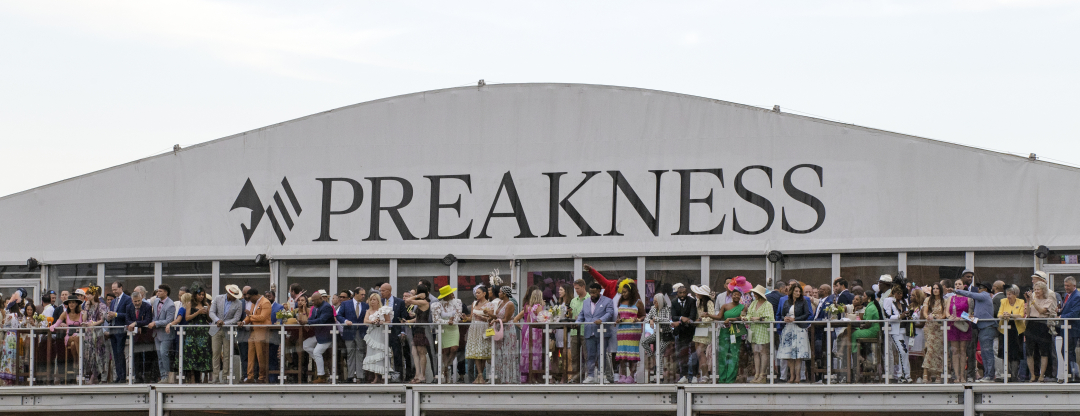
Executives at Churchill Downs Inc. said on Thursday morning during a conference call that a recent agreement to purchase a package of intellectual property rights related to the Preakness Stakes would generate approximately $6 million in revenue each year while also acknowledging that “control” over the race and racing in Maryland remained in the hands of the state.
Bill Carstanjen, the chief executive of CDI, was faced with a half-dozen questions from analysts during the call related to the rights deal, which created confusion in some quarters when it was announced two days ago. In answer to the questions, Carstanjen laid out the parameters of the $85 million deal, which amounted to the acquisition of an agreement to lease back certain rights to Maryland that were previously held by 1/ST Racing and Gaming.
Under that deal, 1/ST Racing accepted a package of intellectual property rights related to the Preakness and Black-Eyed Susan Stakes as part of a larger deal to sell Pimlico and hand over control of Maryland racing to the state. The deal allowed 1/ST Racing to lease the package back to the state in exchange for $3 million, increasing by 2.5 percent each year, plus a 2 percent share of the gross wagering on the Black-Eyed Susan and Preakness cards, which last year had approximately $140 million in handle in total.
A terse release issued by Churchill on Tuesday morning referencing the deal as the acquisition of the “intellectual property, including all trademarks and associated rights” to the two races triggered wide-ranging speculation at some outlets, including the mistaken assertion that Churchill Downs had acquired some kind of control over the broadcast rights to the races and even where the Preakness would be run in the future.
On Tuesday morning, shortly after the release was issued, Churchill officials said that the company would not comment beyond the release until the conference call on Thursday morning.
Carstanjen said during the Thursday conference call that Churchill executives viewed the Preakness as an “iconic asset” and that the company was “thrilled to be a part of it,” but later acknowledged that any decisions regarding the race remained in the hands of the state.
“Maryland is in control of the destiny of the Preakness,” Carstanjen said, adding later, “This is something where the state would have to ask us to help on.”
The conference call was a previously scheduled event to discuss Churchill’s first-quarter earnings, which were released on Wednesday afternoon after the markets had closed.
According to the financial statements, CDI had net income of $83.0 million in the first quarter of 2026, up 7.7 percent compared to net income in the first quarter last year, driven mostly by increased business at its casinos in Kentucky and Virginia. Overall, net revenue in the quarter was a record $663 million, up 3.1 percent over first quarter revenue of $643 million last year.
Although revenue from casinos in states outside of Kentucky and Virginia fell $5 million during the quarter, revenue from historical horse racing machines at casinos in Kentucky jumped $17 million while revenue from the same devices at casinos in Virginia jumped $5 million, according to CDI.
Analysts on the conference call also had numerous questions regarding the company’s future prospects in Virginia, where the state’s governor earlier this month vetoed bills that would have authorized casino-type gambling over the internet and a new casino in Fairfax. Churchill Downs currently has a monopoly on casino-type gambling in the state through its ownership of Colonial Downs and its off-track betting parlors.
When asked whether Churchill expected future legislative efforts to challenge the company’s Virginia monopoly, Carstanjen said that “generally, legislative process are busy, messy processes” and that the company could not predict the exact priorities of legislatures in the future.
“The fact that legislation is introduced doesn’t mean there’s consensus in the state on what is going to happen in the future,” Carstanjen said. “Every year is different in every legislature.”
In other states where Churchill has casinos, overall returns were flat in the first quarter, according to the company’s financial statements. In Louisiana, the company’s casino revenues were down $9 million due to a state Supreme Court decision last year that forced CDI to remove historical horse racing machines from its gambling properties. Revenue from casinos in Mississippi and Florida were also down $2 million.
Like other gambling companies, CDI is dealing with soft consumer spending at many of its casinos, partially due to increased competition in the gambling market and also due to cost-of-living pressures on casino demographics.
Marcia Dall, the company’s chief financial officer, said on the conference call that first-quarter casino revenue was within the company’s expectations, and she said that high-spending customers continued to play at strong rates, among better trends for all customers compared to early 2025.
“Customer trends have improved over the prior year,” Dall said. “We see continued strength among the rated players.”
While overall net revenue increased 3.1 percent, operating expenses during the quarter jumped 2.7 percent, from $508 million last year to $520 million this year, according to the financial statements.
Churchill’s account-wagering companies, including Twinspires.com and Velocity – an ADW catering to computer-assisted wagering parties – had net revenue of $118 million in the first quarter, up from $116 million in the first quarter of last year. Churchill said the increase was due primarily to jumps in its “retail sports betting business.”
In early trading on Thursday, Churchill’s stock price was down 2.1 percent. The stock is trading 24.9 percent below its 52-week high of $118.45 in mid-December.
:: Want to learn more about handicapping and wagering? Check out DRF's Handicapping 101 and Wagering 101 pages.