
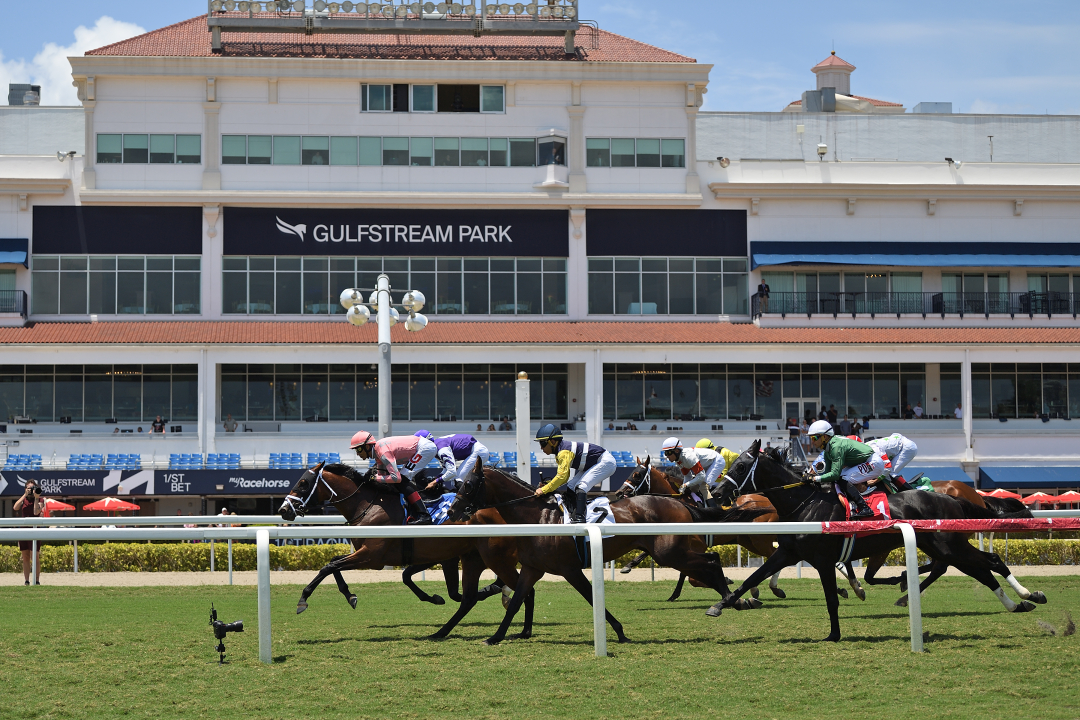
A Florida state representative has introduced a bill that would allow Gulfstream Park in Hallandale Beach to cease live racing in 2030 while continuing to operate its casino.
Rep. Adam Anderson, a real-estate developer who spearheaded a similar legislative effort earlier this year that ultimately failed, filed the bill Tuesday, giving notice to the state’s racing industry that a decoupling battle will once again be staged in the state legislature in 2026.
The bill would allow Gulfstream Park’s owner, 1/ST Racing and Gaming, to give notice of its intention to cease live racing in the summer of 2027. Once the notice is given, racing could cease at the property three years later.
The bill also includes language that would allow a “Thoroughbred permitholder” to stage live racing at a facility within 50 miles of the track, a radius that would include Palm Meadows Training Center, which also is owned by 1/ST.
In addition, the bill would allow Hialeah Park, a once storied Thoroughbred track in South Florida, to convert its current Quarter Horse racing permit into a Thoroughbred permit within one year of the legislation passing. The language of the bill limits the operator of a Thoroughbred meet at the track to a “not-for-profit corporation formed under state law to serve the purpose of the state.”
Nearly every Thoroughbred constituency in Florida opposed the decoupling effort earlier this year, but those groups have been talking throughout the last half of 2025 on alternate plans to maintain significant live racing dates in South Florida or elsewhere if the decoupling effort succeeds or Gulfstream is sold. Those plans include the exploration of the construction of a new track in Ocala, the center of Florida’s Thoroughbred breeding and training community [https://www.drf.com/news/global-symposium-racing-ftboa-planning-build-r…].
Last year, Anderson’s bill passed the House but stalled in the Senate after Florida Gov. Ron DeSantis publicly stated that he opposed the legislation and vowed to stand behind agrarian Thoroughbred interests. But the real-estate lobby in South Florida is extraordinarily influential in the state, and most supporters of the bill have taken to characterizing opposition to the legislation as a defense of a dying industry.
“It is not the legislature’s responsibility to force a business to operate a line of business that may not be profitable,” Anderson said during a hearing last year in which the previous bill was advanced.
Gulfstream sits on extremely valuable land that could easily be worth hundreds of millions of dollars to a developer interested in converting the property to mixed use. 1/ST Racing operates a small casino on the property whose revenues are dwarfed by the gambling profits generated at enormous casinos operated in the state by the Seminole Indian tribe.
The bill was introduced at a time when 1/ST Racing and the Florida Horsemen’s Benevolent and Protective Association, which represents owners and trainers at the track, are negotiating a live racing agreement for 2026. The previous agreement expires as of Dec. 31.
Although its current permit only requires 40 dates, Gulfstream currently runs year-round on a schedule that totals approximately 200 live racing dates. Recently, Gulfstream announced minor increases to its purses for 2026, despite the lack of an agreement.
Last week, a coalition of racing constituencies released a statement citing the expiring agreement, saying that the “impasse presents significant industry hazards.” Racetracks are required to have a live racing agreement with their horsemen in order to send or receive simulcasts under the federal Interstate Horseracing Act.
:: Want to learn more about handicapping and wagering? Check out DRF's Handicapping 101 and Wagering 101 pages.